Contents:
-
- Introduction
-
-
-
Vision
-
Mission
-
Expectations
-
Activities undertaken for Research and Development Cell
-
-
Project and Consultancy
-
Publication
-
Workshop and Conference
-
MoU
-
IPR
-
Policies for procurement of Goods and Services
-
Research Policy
-
-
Research Centre
-
Research areas
-
Research labs
-
Role of R & D Cell
1. Introduction:
IIIT Bhubaneswar owes its origins to the initiative of the Odisha Government. It is a result of the desire of the Government to establish a world class Institute of Information Technology in the state. The Institute has been registered as a society in Nov 2006. In January 2014, the Institute is converted to a University by the Government of Odisha.
Since its inception, IIIT-Bhubaneswar, with its unique model of education, research, and industry interaction, has grown in stature to become an institution of considerable repute in academic as well as corporate circles. The Institute works in partnership with the corporate sector, while retaining the freedom of an academic institution. It is inspired by other renowned institutions, and also strives to emulate an academic culture that is on par with the best international institutions.
The R & D Cell is an integral part of any Institute of national and international repute that meets the Vision and Mission of the Institute.
Vision:
The Office of R & D Cell, IIIT Bhubaneswar will create an outstanding ecosystem for research and development that develops knowledge and contribute to the economic growth and societal development of the nation and benefit humanity as a whole.
Mission:
To enable the achievement of excellence by the research community, the Office of R & D Cell:
-
Develops and expands innovative research programs that align well with institutional mission and vision
-
Enhances and encourages faculty members and research scholars to obtain and manage grants
-
Supports strong infrastructure for interdisciplinary research
-
Promotes the ethical conduct of research, awareness, and compliance
-
Partners with the research community
-
Creates integrated services, transparent research administration, and streamlined processes
Expectations:
The institutional expectations from faculty and research scholars include the following:
i. Commitment to Research Quality:
-
Creating or associating with a formal research group/ lab/ research centre.
-
Documenting the details of projects, members, processes, activities and outcomes.
-
Scheduling the activities like periodic seminar talks, research meetings etc.
ii. Research Ethics:
-
Conduct of awareness meetings about research ethics involving but not limited to the following issues: plagiarism, research claims, managing human subjects, privacy protection, data security, ethics of online behavior, IPR etc.
iii. Resource Generation:
-
Proactively involve yourself in proposing research projects to research centres or external funding agencies.
-
Actively collaborate with other faculty members and external agencies to propose research agendas that push the state of the art, and/or addresses relevant social challenges.
iv. Social Outreach:
2. Activities undertaken for Research and Development Cell
The R & D Cell has been constituted to promote research & development activities leading to Project and Consultancy, Publication, Workshop and Conferences, MoU, Patent filing and IPR.
A. Project and Consultancy
Funding for projects is sponsored by various stakeholders. Those are
(i) Government Sponsored Projects
Government sponsor projects which have tangible deliverable and likely to impact the society at large. Various Govt funding agencies are as follows:
a. Government of Odisha
b. Department of Science and Technology (DST)
c. Ministry of Electronics and Information Technology (MeitY)
d. Science and Engineering Research Board (SERB)
e. State University Research Excellence (SERB-SURE)
f. DRDO, DAE and ISRO, DoS
g. other agencies like DBT, NAL, HAL, BEL, BHEL, OURIIP etc
(ii) Corporate CSR Funded Projects
Corporate Social Responsibility (CSR) is the funding and grants under which Research Institution can get financial and other support from the corporate sector. Companies sponsor projects and research which are path breaking and likely to have impact on the society as a whole.
(iii) Academia/Institution Funded Projects
-
Research institution often collaborate with institution seeking the expertise available in the institute. Topics which are multi-disciplinary in nature often find sponsorship from universities and institution of repute.
-
Seed Grant up to 5 Lac from the Institute for research promotion scheme
(iv) Industry Driven Projects
Some projects are industry driven where it is domain specific and the company invest in projects and topic which are relevant and important in transformation of their future operation.
(v) Fellowships and Grants Available:
Research scholars registered for a research programme can avail scholarship through Fellowship from Government under schemes through DST, CSIR, OURIIP etc. Research Scholar can also avail fellowship from industry/company sponsored projects such as:
a. Ministry of Electronics and Information Technology, Government of India initiated “Visvesvaraya PhD Scheme for Electronics and IT”
b. Young Faculty Research Fellowship.
c. SERB CRG grant
d. Empowerment and Equity Opportunities for Excellence in Science (EMEQ)
e. OURIIP, Odisha State Higher Education Council
f. Women Scientist Programme (DST) etc
Motivate Faculty Members for Applying Project Proposals.
-
Prepare a brochure containing relevant information
-
Conduct of sensitisation programmes
-
Scrutinizing the research project proposals for submission to the funding agencies
-
Monitoring the progress of the research projects
B. Publications:
-
Scrutinize the Journal and Conference incentives for Faculty Members.
-
Institute may pay the publication fees to publish highly recommended open access journals.
-
Journal Incentive is upto Rs 30,000 as per office order Ref No: IIIT-BH.
-
Faculty of the Year Award may be honoured. Tentative Format is attached [Annexure I]
-
Student of the Year Award for B. Tech, M Tech and PhD may be given.
C. Workshop and Conferences:
-
Fund should be allotted to conduct the workshop and conferences in the Institute.
-
Reimbursement limits for presenting paper at National and International Conferences to the full-time faculty members w.r.t. office order Ref No: IIIT-BH/28005/6259 Dated 28th Aug 2018.
-
Advance option should be open to attend the workshop and conference.
D. MoU
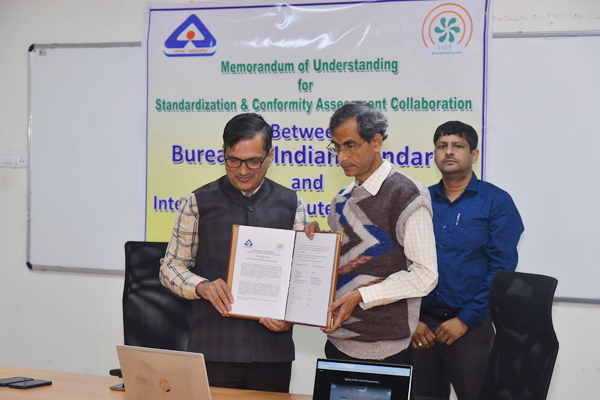
A Memorandum of Understanding (MoU) is an agreement between two or more parties planning to create cooperative research and/or educational partnership.
-
Joint collaborative research projects in cutting technology.
-
Joint organisation of technical meetings, international workshops, conferences, seminars, certification-based courses, faculty development programs for internal and external candidates.
-
Exchange faculty members and student’s/Research scholars for mutually agreed durations and terms and conditions.
-
Helping consultancy projects in areas of mutual interest.
It may be of two types:
-
MoU with Industry
-
MoU with Academic Institutes (Institute Level)
** MoU Format (Tentative): Annexure II
E. Intellectual Property Right (IPR) and Patents:
1. Promote to file patent and copy-right of their inventions.
2. If a paper is published by a scholar/faculty, his work should have the IPR of the Institute.
3. Fees for Patents.
a. An employee whose duties involve carrying out Scientific or Technical Research may apply for a patent for inventions attributable to him for his work carried out in the Institute, to be jointly owned by the Institute and the employee.
b. The fees for filing the patent shall be paid by the Institute, if the Institute deems fit for patent filing.
3. Policies for procurement of Goods and Services
1. Outstation Travel/ Experts Visit for any R and D Event/ Attending Conferences
2. Outstation Local Travel
3. Information and Faculty Brochure
4. Memento/Gifts/Stationaries
5. Competition (Travel Grant/Prize Money/Accommodation etc)
**Policies for procurement may be followed similar to SoP of Placement and Institution guidelines.
4. Research Policy
Research is an integral part of the institutional mission of IIIT Bhubaneswar. All faculty members have PhDs from reputed institutions of India. They are expected to pursue an active research agenda in addition to their teaching, administration and outreach responsibilities.
IIIT Bhubaneswar has the following modalities of research engagements with students:
-
PhD Scholars, MTech and B Tech students
-
Research associates and visiting scholars
-
JRF and SRF from project grant
In addition to the above, IIIT Bhubaneswar has laid out several institutional mechanisms to foster a culture of research and aid researchers in reaching out to stakeholders in the industry and society at large. These include the following: A. Research Centre B. Research areas C. Research labs
A. Research Centre
The research Centres at IIIT Bhubaneswar are multi-disciplinary with participation from several faculty members across different research domains. These centres run by faculty and driven by students and staff, have active collaborations with academia, government, and industry.
B. Research Areas: The areas under which active research are going on is as follows
Computer Science
-
Computer Vision
-
Information Security
-
Data Sciences
-
Bio-informatics
-
Machine Learning
-
Natural Language Processing
-
IoT and Cloud Computing
-
High Performance Computing
Electronics and Telecommunication
-
VLSI and Signal Processing
-
RF & Microwave Circuits and Antenna Design
-
Signal and Image Processing
-
Optical Communication
-
Microcontroller & IoT
Electrical Engineering
-
Power Quality
-
Signal Processing
-
Power system Protection
-
Power distribution network reconfiguration
-
Renewable Energy
-
Soft Computing
Mechanical Engineering
-
Nonlinear Dynamics, Stability and Bifurcation Analysis
-
Heat Transfer
Mathematics and Basic Sciences
-
Computational Chemistry
-
Centre for the Study of World Literature
-
Optimization
C. Research Labs:
Various Research labs of world class standard related to various research areas are required to set up in IIIT Bhubaneswar to assist the research activity.
5. Role of R & D Cell:
The committee when evaluating the proposal, it should consider the following
-
Whether the proposal is in line with spirit of the fund provided by the Sponsor
-
Whether the research will convey the relevance and impact it will produce on the society
-
Whether the Proposal is technically sound.
-
Whether the space of work is clearly spelt out and role of each party in achieving the work is clearly spelt out
-
Whether the financial budgeted and requested in commensurate with the scope of the work put out in proposal
-
Whether the scope of work identifies the milestones and also spells out the financials to be disbursed on achieving the milestone.
-
Whether the proposal clearly specifies the IP right of the parties involved.
The committee will either approve or reject the proposal based on the findings from the proposal. The Committee will suggest the PI to consider the necessary changes and submit for approval.
Apart from Project and Consultancy, the activities undertaken by the R & D Cell are workshop and conference, Publication, MOU, IPR & Patents and any other assignments assigned by the competent authority from time to time.
Contact:
Head, R & D Cell
# B111, Block B, First Floor
Email: offrdcell@iiit-bh.ac.in